Article
How I used “phishing” to prepare a birthday surprise for my girlfriend
By Gustavo Costa•11/15/2026

Some people hide the cake. I prepared a made-up company, a website and an invitation to a market research discussion.
My girlfriend misses her cousins who live in different countries. I wanted to bring everyone together for a birthday call, but “join this meeting for a second” might give the surprise away. I needed a story that explained why she should reserve the time without revealing the meeting’s real subject: her.
That is how a family celebration acquired an international research production.
First, a company that seemed to exist
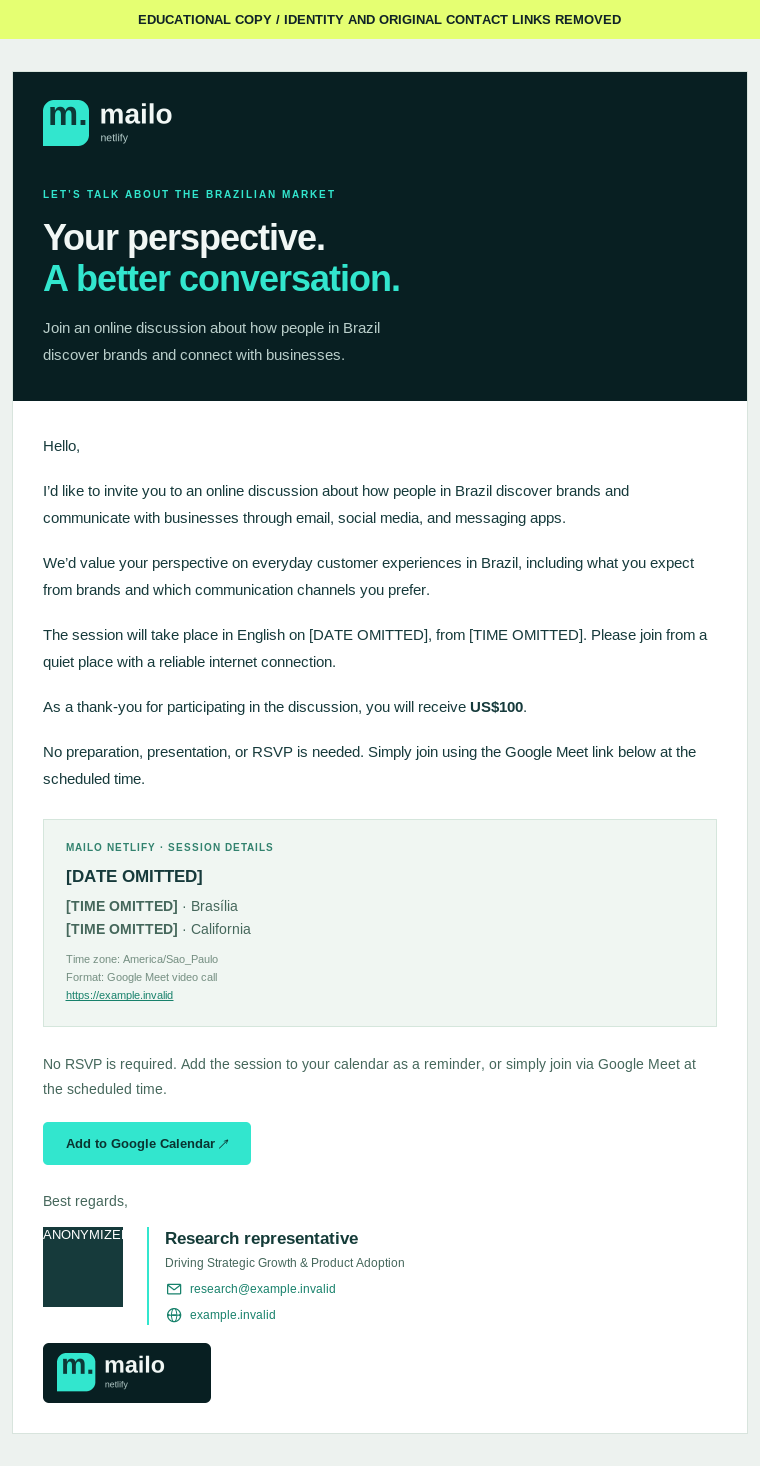
I chose the company name to match the platform hosting the site, so the domain would look consistent with the identity presented in the invitation.
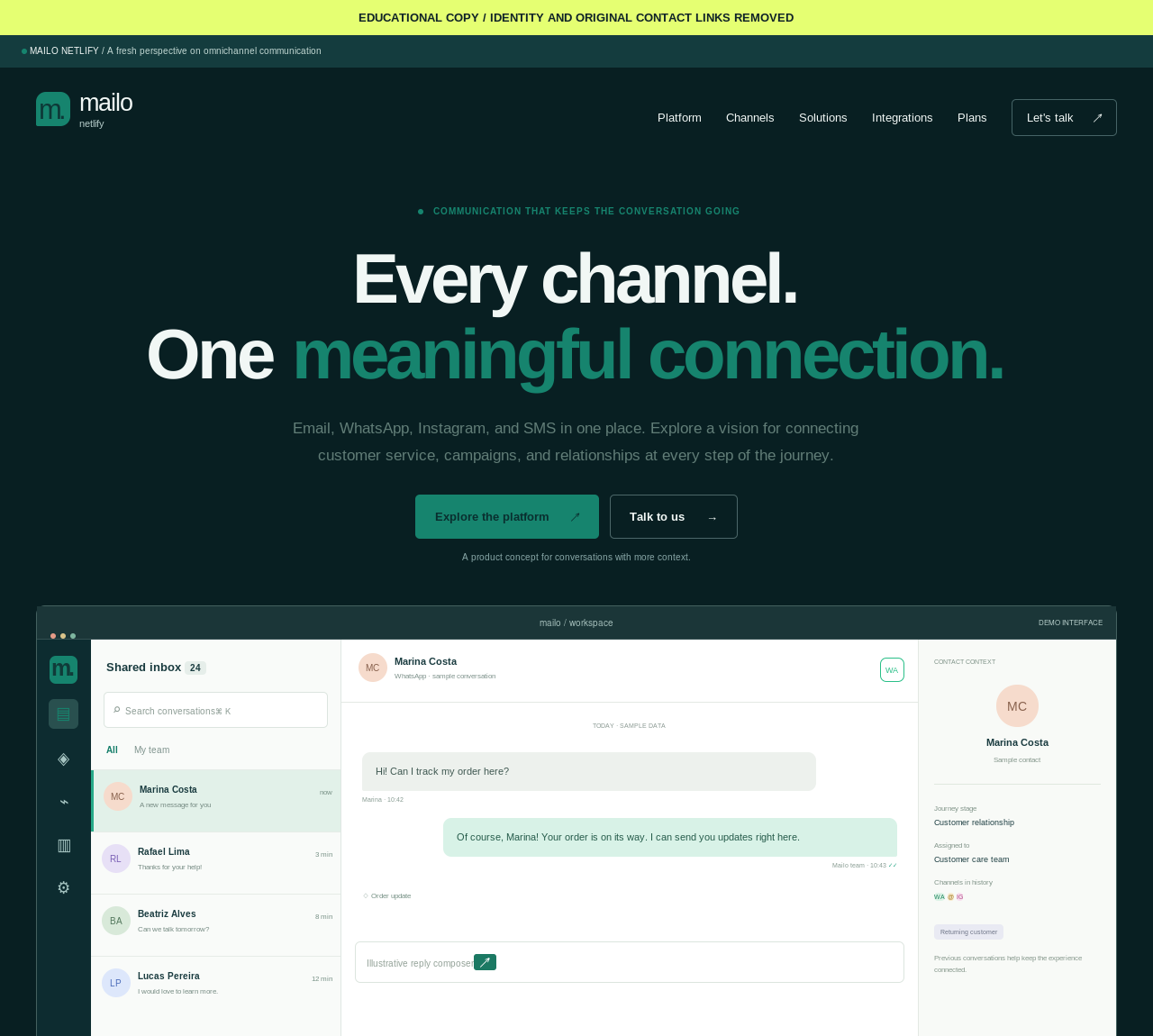
The page described a communications business, with services, messaging channels and a product interface. If she looked for more information about the invitation, I wanted her to find a professional presence consistent with what she had received.
The website was part of the persuasion. A well-organized page can move someone from “Who is contacting me?” to “I understand what this company does.” That feeling of familiarity does not establish who is behind it.
Then, an invitation that made sense for her
The story was an English-language conversation about the Brazilian market, with US$100 for participating. It matched her fluent English and experience of life in Brazil. I could also explain personally that I had referred her.
I chose the representative, signature, job title and wording. The email needed to look like a professional invitation consistent with the website and make the next step clear: attend a conversation, without preparing a presentation or studying a topic beforehand.
Each detail had a purpose. The topic explained why she had been selected. The reward gave her a reason to reserve the time. The signature introduced someone responsible for the contact. The referral connected the proposal to someone she already trusted.
For a round of “Happy Birthday,” I had acquired a small communications department.
Where does phishing fit into the story?
Phishing is a deceptive approach that makes a message appear trustworthy to get someone to act. In a scam, that action might be sharing a password, paying a fake invoice or installing malicious software.
When the message is tailored to a particular person, it is called spear phishing. Think of bait made for one recipient: the subject, context and proposal are chosen to make sense to them.
In my plan, the destination was a family celebration. But the mechanics that made the invitation convincing are also worth recognizing in a malicious approach.
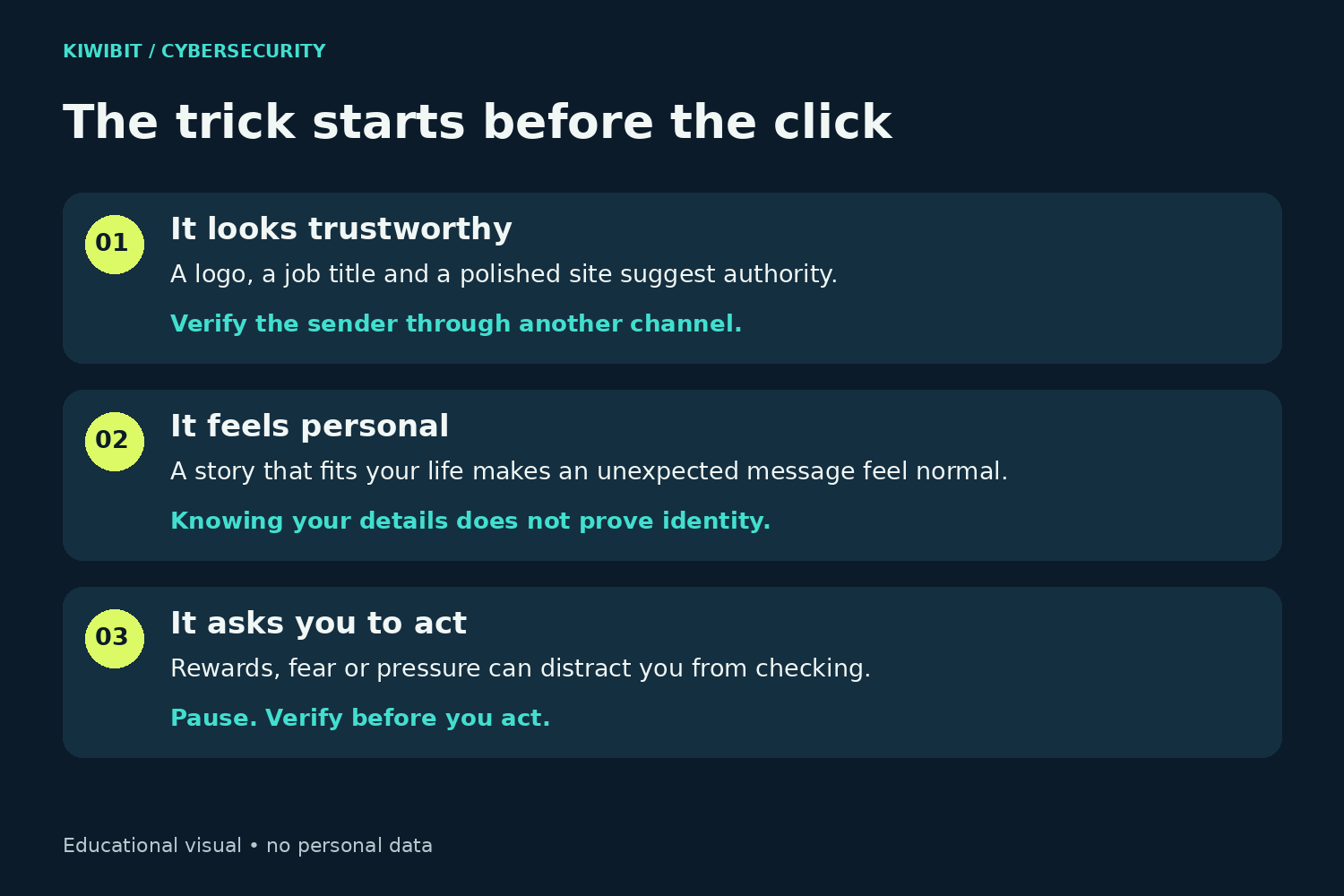
It combined three elements:
- Relevance: the invitation matched her language skills and experience, giving an unexpected contact an explanation.
- Apparent authority: the website, job title and signature suggested a professional organization behind the conversation.
- Motivation: the reward and personal referral gave her reasons to consider the proposal.
The NIST Phish Scale considers both message characteristics and recipient context when assessing how difficult phishing is to recognize. A story that fits your life can be harder to question than an obviously absurd promise.
Several references can tell the same lie
The email introduced the company. The website seemed to confirm the email. The signature reinforced the identity. The names and addresses appeared to match.
There was just one detail: every reference had been prepared by the same person. Me.
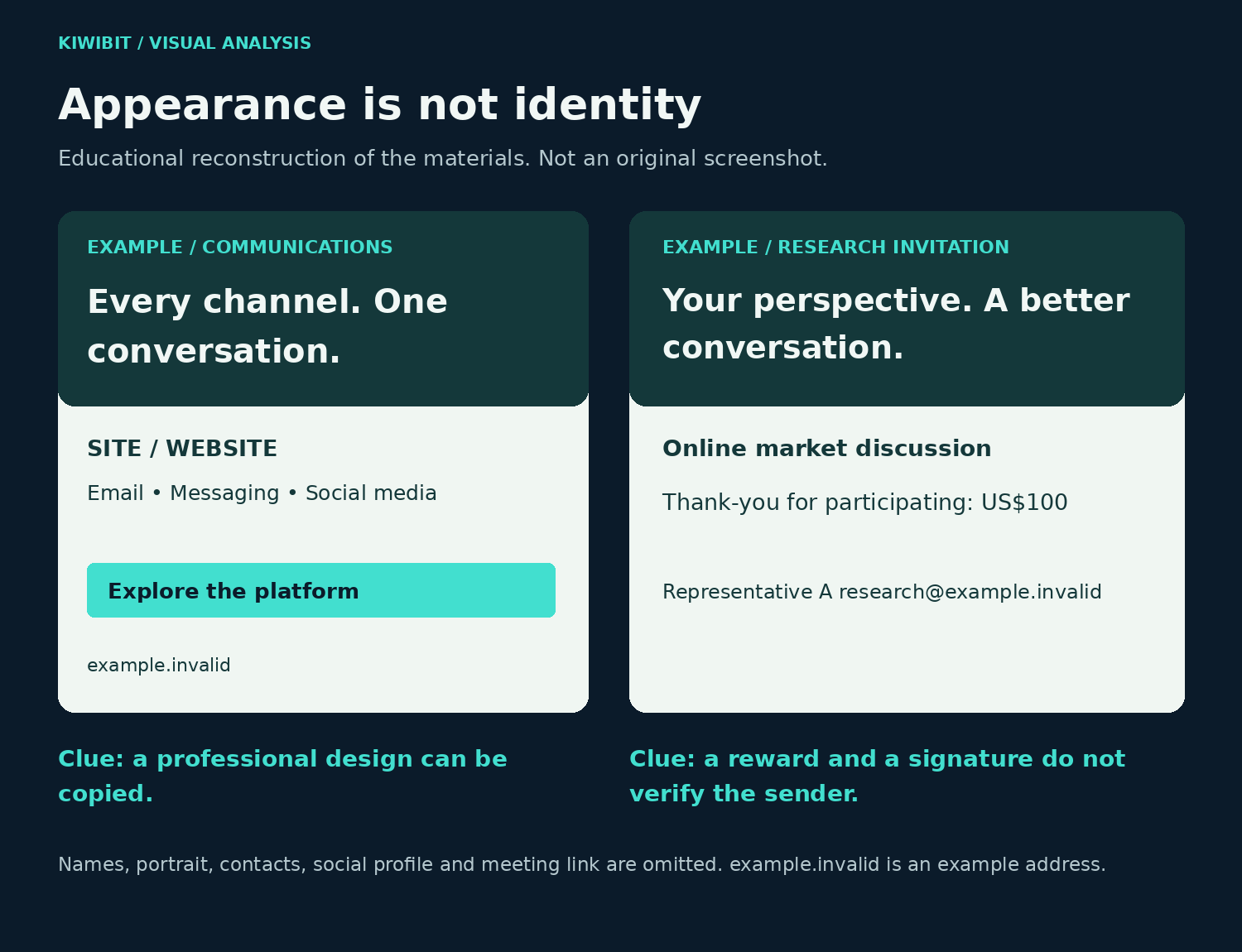
It is easy to mistake consistency for confirmation. You open a polished page, find organized information and feel that you have checked the message. But if the sender created that page too, you have only visited another part of the same story.
The same caution applies to a professional profile. A person can really exist without having sent that message. A page hosted on a familiar service does not mean the offer comes from that service either.
Even the browser padlock answers a different question: it indicates a protected connection to an address, not that the proposal is true.
What about the spelling mistakes everyone tells us to look for?
They can be a warning. Their absence is not a guarantee.
Cormac Herley of Microsoft Research discussed the idea that unlikely stories can discourage people who would become suspicious later, saving scammers time. His 2012 study examines this selection in advance-fee scams; it does not establish that writing mistakes are generally deliberate.
My invitation needed to avoid feeling strange. A personalized approach can arrive with natural language, professional presentation and a relevant subject. Checking only for mistakes leaves a lot out.
AI reduces the production work
I used AI to help develop the materials. I chose the story, the names and the reasons the invitation might seem plausible; the tools helped produce text, images and a page.
That is one risk of malicious use: it becomes easier to turn an invented story into professional-looking materials and adapt the communication to different audiences.
The Canadian Centre for Cyber Security’s 2025–2026 assessment describes malicious actors using AI to produce personalized, grammatically correct phishing.
Appearance remains a clue about how a message was presented. It is not proof of who sent it.
When a fake conversation opens a real door
So far, this story involved cousins, a call and a birthday. Replace the celebration with access to a work computer, and the impact changes completely.
According to Binance’s initial report on its October 2026 incident, an employee went through fake job interviews and received a test containing malicious code. The company describes a multi-stage campaign, not an incident caused only by an email.
The connection to my story is context: a plausible situation made the next request seem normal. Research can explain a request to reserve time; an interview can explain a test. Neither establishes the sender’s identity or makes a file safe to run.
For an individual, the consequences can include lost money and stolen accounts. For a company, one compromised computer can provide a route to other systems. Protection needs to combine identity verification, limited access and procedures that do not rely entirely on one person’s attention.
In 2025, the FBI’s Internet Crime Complaint Center, IC3, received 191,561 phishing/spoofing complaints. Reported losses across all crime categories combined reached US$20.877 billion. These are reports to IC3, not a complete global picture; the total loss is not attributable entirely to phishing. Source: IC3 2025 report, pages 6–7.
How to check the story without becoming a detective
The most useful step is to leave the route provided by the message and look for independent confirmation.
- Find the contact yourself. Use an official channel or someone you already know. The FTC recommends verification outside the contact details provided in the message.
- Check complete addresses. Display names, logos and signatures can be copied. Check who sent the message and where its links lead.
- Reassess when the request changes. If a conversation starts requiring passwords, verification codes, payments or software installation, pause and verify. That includes job interviews.
- Protect your accounts. Use different passwords, a password manager and a second authentication step. CERT.br’s authentication guidance explains these measures in Portuguese.
- Ask for help early. If you shared information, installed something or transferred money, contact official support and, where needed, your bank. Preserve the messages. CERT.br provides scam response guidance in Portuguese.
My preparation had a personal goal: bringing loved ones together without revealing the surprise. The story shows how seemingly small details can support each other until the whole presentation feels convincing.
The next time a message seems to fit your life perfectly, ask: who confirmed this story besides the person telling it?
Because my plan included cake. A criminal’s ending can be very different.